Tuesday, October 03, 2006

Bande mein tha dum - Remembering Gandhi...

Yesterday was Gandhi Jayanti, the birth anniversary of Mahatma Gandhi, one of the greatest leades of the last century. I received 7 sms conveying best wishes for the day. This is roughly 7 more than what I received last year. Is there a resurgence of Gandhi 58 years after he was silenced by 3 bullets? Or is this short lived euphoria over the success of a comic film? Whatever it is... lage raho!!

According to historian Michael H Hart, there are three ways to judge the success of a person:

(i) The smallness of means;
(ii) The greatness of purpose; and
(iii) The results achieved.

MEANS...
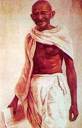
If we look at Gandhi through these lenses we find that he was a frail short man (5 ft 3") with no political godfather, no family business to fall back on, no support.. infact nothing as apparent means. What he did have was greatness of purpose and his tools of Ahimsa (non-violence), Satya (Truth) and Simplicity.

PURPOSE...

His purpose was great - to take on the entire British empire - perhaps more daring than someone taking on the USA today for seeking freedom for a fifth of the world's population and ... that's the catch... WITHOUT ANY VIOLENCE. These surely make the plan great... I mean greatly difficult to achieve. I daresay none of us would even have the courage to take up such a task!

But Ah! ... he had COURAGE, in capital bold letters, font 220 ... and that arose because of his clear conscience and adherence to Truth and non-violence. How many of us would have the courage when we are to meet the King of the British Empire (as Gandhi was invited to in 1913), to go there in our dhoti and shawl and on being asked if we weren't under-dressed for the occasion, coolly reply, "His Highness was wearing enough for both of us!"

True... one man with courage makes a majority!!

RESULTS...

And the results - they speak for themselves - freedom achieved without violence, an exemplary ascetic life, the respect of seniors and the love of children, a storehouse of writings (atleast 50,000 pages, as published by the Government of India) and the spiritual father to non-violence adherents such as Martin Luther King, Nelson Mandela, Dalai Lama and Aung San Suu Kyi among others.

SO...

Einstein said of Mahatma Gandhi (and no, he had never met him, only corresponded with him) - "Generations to come will scarce believe that such a one as this ever in flesh and blood walked the earth"

We, as heirs of the Gandhi legacy, have a right, nay a duty, to create India's identity with Gandhi's ideals - showing to the world that we deserve and respect Gandhi's heritage, of providing alternate solutions to the conflict and problems in the world today. As Gandhi said, "What difference does it make to the dead, the orphans, and the homeless, whether the mad destruction is wrought under the name of totalitarianism or the holy name of liberty and democracy?"

Let our remembrance not be short-lived. Let us adopt his ideals in our life..

Let us remember this picture in all that we do from now on:
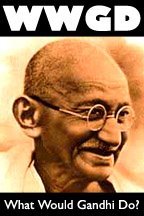


In all our actions, in all our speech, in all our thoughts, let us think WWGD - 'What Would Gandhi Do In This Situation'.. and then act accordingly.

Saturday, July 01, 2006

Amrapali’s Encounter with The Handsome Renunciate

From a post by P VENKATESH on the Speaking Tree (Times of India)

An interesting story on happiness and true pleasure...

The most attractive thing in Vaishali, the capital city of Lichhavis, was the beautiful dancer Amrapali. She was named after the mango grove she was first found in. Everybody was eager to win her love. She chose to be the Nagar-vadhu, wife to the whole city.

One day, Amrapali saw a young monk. Mesmerised by his calm and attractive pre-sence, she followed him. The sanyasi settled down beneath a mango tree, unmindful of her presence. Unable to attract his attention, she spoke: “Sir, please introduce yourself. Why do you lead an ascetic life in your youth?” “In search of Truth”, replied the monk. Amrapali was first taken aback. She then teased him: “Of what use is the Truth that wastes your youth?” The monk smiled: “Lady, Absolute Happiness can only be attained thus for the happiness you seek is transitory pleasure”.

Amrapali persisted. “Dear, leave this delusion and enjoy my hospitality which even royalty desires to experience”, offered Amrapali. The monk thought for a moment and said, “I will ask my master. If he allows me, I will come”. Then he took out a ripe Amra Phal (mango) from his bag and gave it to her with the instruction that the fruit be preserved without decay till his return.

The monk returned to Buddha’s shelter and narrated the incident. Buddha gave him permission to stay with Amrapali, much to the puzzlement of other disciples. Buddha calmly said, “I have looked into his eyes — there was no desire. If I had said ‘no’, even then he would have obliged. I trust his meditation”.

In the meantime, Amrapali tried all methods to keep the mango fresh, but failed. After one month, the young monk returned. Passionately infatuated, she approached him. The monk ordered, “Lady! Bring me the Amra Phal”. She did so; but the mango had decayed, emitting foul odour and was full of worms. She asked, “Dear, of what use is this rotten fruit to you?” The monk slowly removed the mango-stone from the fruit. Showing her the rotten skin, he spoke, “Where has the beauty, aroma and taste of the fruit gone? Whereas, the mango-stone is intact and free of decay”. “Of what use is this mangostone”, argued the courtesan.

The monk smilingly explained, “The mango-stone is the most useful. As a seed, it has the potential to regenerate a new body. Likewise, a human being’s meditation is never wasted. This mangostone signifies the eternal Soul. The protection of the Soul is the real shield; that is the absolute Happiness. Recognise this Truth, Amrapali. You, who could not save the decay of this Amra Phal, how long can you protect your own body from disintegration?”

The Nagarvadhu was speechless; it was as if she had been awakened from a deep sleep. Moved, she asked forgiveness of the young monk. She felt cleansed and expressed her desire to see the monk’s master. Later, Buddha visited Vaishali and stayed at Amrapali’s abode. She touched Buddha’s feet and said, “I tried my best to attract your monk, but he convinced me by his awareness that real life is in your shelter”. She renunciated the life of a courtesan and donated her belongings to the Buddhist Sangha.

Tuesday, June 27, 2006

On human happiness...


"Now and then it's good to pause in our pursuit of happiness and just be happy", so said Guillaume Apollinaire, the foremost French poet of the early 20th century. The quest for happiness has been the single purpose of human existence. And often in vain.

In a world of strife, we have ensured that happiness is a distant dream for many; and survival more important than happiness.

When does a human being achieve happiness and how can it be measured? Is 'fun' as perceived today a quick pill for happiness? Or do we program ourselves to remain unhappy?

The Master claimed that a major reason for unhappiness in the world is the secret pleasure people take in being miserable.
He told of a friend who said to his wife, "Why don't you get away and have a good time, darling?"
"Now, dear, you know perfectly well that I never enjoy a good time!"
(Anthony de Mello, S.J.)

Saturday, January 01, 2005

Hi.. Welcome to my world

Hi,

I am a fellow human being... call me Abrahim for convenience....

Welcome!!