Saturday, April 21, 2007

Wrath - the fourth deadly sin

A useful reminder, again from Paulo Coelho...

WRATH

According to the dictionary:

feminine noun, from the Latin Ira. Choler, anger, indignation, rage, desire for revenge.

For the Catholic Church:

Wrath is not only against others, but can turn back against someone who lets hate sow seeds in his heart. In this case usually he is led to suicide. We need to understand that punishment and its imposition belong to God.

In “Verba Seniorum” (The Word of the Ancients):

Two wise men who lived in the same chapel in the Sahara desert, chatted one day: “Let’s fight so that we don’t become disassociated from the human being, or we will end up not understanding properly the passions that torture him”, said one of them.

“I don’t know how to begin a fight”.

“Well, we will do the following: I am putting this brick here in the middle, and you say to me: it’s mine. I will answer: no, this brick is mine. Then we will begin arguing and we will end up fighting”.

And so they did. One said that the brick was his. The other argued, saying it was not.

“Don’t let’s waste time over this, keep this brick,” said the first. “Your idea for a fight was not very good. When we perceive that we have an immortal soul, it is impossible to fight over things”.

Credits: Text Credits: Picture

Saturday, April 07, 2007

Advice to teachers...


The following is a wonderfully written piece attributed, albeit wrongfully, to Abraham Lincoln. It contains some sound advice from a father to his son's headmaster, requesting him to teach not only books, but also life. An inspirational read....


He will have to learn , I know,

That all men are not just,

All men are not true,

But teach him also ,

That for every scoundrel there is a hero,

For every selfish politician,

There is a dedicated leader……


Teach him ,that for every enemy there is a friend,

It will take time I know but teach him if you can,

That a dollar earned is of far more value than five found

Teach him to learn to lose and also to enjoy winning.


Steer him away from envy, if you can

And teach him the secret of quiet laughter


Let him learn early ,that the bullies are the easiest to lick…

Teach him if you can, the wonder of books…

But also give him quiet time, to ponder over the eternal mystery of birds in the sky,

Bees in the sun and flowers on the green hillside.


In school, teach him, it is far more honourable to fail than to cheat….


Teach him to have faith in his own ideas,

Even if everyone tells him they are wrong…..


Teach him to be gentle with gentle people

And tough with the tough…


Try to give my son the strength, not to follow the crowd when everyone is getting onto the bandwagon,

Teach him to listen to all men,

But teach him also to filter all he hears on a screen of truth,

And take only the good that comes through.


Teach him if you can, how to laugh when he is sad….

Teach him there is no shame in tears,

Teach him to scoff at cynics,

And to beware of too much sweetness….


Teach him to sell his brawn and brain to the highest bidders,

But never to put a price tag on his heart and soul.


Teach him to close his ears to a howling mob..

And to stand and fight if he thinks he is right.


Treat him gently , but do not cuddle him,

Because only the test of fire makes fine steel.


Let him have the courage to be impatient ,

Let him have the patience to be brave.


Teach him always to have sublime faith in himself,

Because then he will always have sublime faith in mankind.


This is a big order , but see what you can do,

He is such a fine little fellow , my son.


PS: Nobody seems to know the real author of the piece. Although commonly attributed to Abe Lincoln, it is not included in any of his works. Read further here.

Sunday, March 25, 2007

Prayer from a church in Russia

Paulo Coelho writes about a prayer he found while on his commemorative journey in Russia. The text was found in a Church in Novosibirsk and was in Russian. The translator who made it understandable to Coelho mentioned that the inscription was part of the Ojibwa tradition. Although I have never heard of this tradition, I found the prayer very powerful. Here it is:

"I come to thee as one of your children. I am fallible and small; I need Your wisdom and strength.

Let me walk in Your beauty, and make my eyes always see the red and purple of dusk. Make my hands respect the things that You have created, and enable my ears to understand Your voice.

Make me wise so that I can absorb what You have taught my people and learn the lessons that you have hidden in each leaf and each rock.

I beg you for strength and wisdom, not to be better than my brothers but so that I can defeat the worst enemy I have: myself. In that way, my spirit will be able to return to you without sin."
giant hands
Originally uploaded by snizz.
Amen.

Tuesday, March 20, 2007

Symptoms of inner peace

Be on the lookout for symptoms of inner peace. The hearts of a great many have already been exposed to inner peace and it is possible that people everywhere could come down with it in epidemic proportions. This could pose a serious threat to what has, up to now, been a fairly stable condition of conflict in the world.

Some signs to look for:
  • A tendency to think and act spontaneously rather than on fears based on past experiences.
  • An unmistakeable ability to enjoy each moment.
  • A loss of interest in judging other people.
  • A loss of interest in interpreting the actions of others.
  • A loss of interest in conflict.
  • A loss of the ability to worry. (This is a very serious symptom.)
  • Frequent, overwhelming episodes of appreciation.
  • Contented feelings of connectedness with others and nature.
  • Frequent attacks of smiling.
  • An increasing tendency to let things happen rather than make them happen.
  • An increased susceptibility to the love offered by others as well as the uncontrollable urge to extend it.

Monday, December 18, 2006

Irom Sharmila- The Unlikley Outlaw

Who is Irom Sharmila?

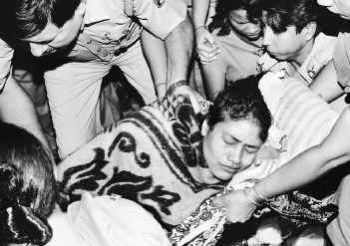
Irom Sharmila is a 34 year old ordinary woman from Manipur. Except that she has been carrying out a UNIQUE protest from the last 6 years, following all the tenets of Gandhigiri that we have just learnt about. And yet, nobody has heard about it!

Everywhere in the country, those who took to arms and unleashed mayhem were heard by the Government of India. Here is a woman staging an epic protest. she will not eat or drink until the Armed Forces Special Powers Act in Manipur is abrogated. She has not eaten or had a drop of water in the last six years! No one anywhere in the world has fought a struggle such as hers. Is Irom Sharmila to fail merely because she doesn’t wield a gun?

The Unlikley Outlaw

An ordinary November evening in Delhi. A slow halting voice breaks into your consciousness. “How shall I explain? It is not a punishment, but my bounden duty…” A haunting phrase in a haunting voice, made slow with pain yet magnetic in its moral force. “My bounden duty.” What can be bounden duty in an India bursting with the excitements of its economic boom?
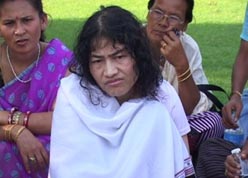
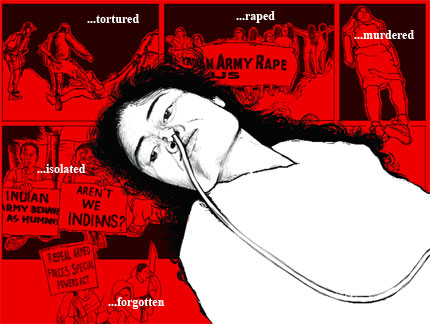
You are tempted to walk away. You are busy and the voice is not violent in its beckoning. But then an image starts to take shape. A frail, fair woman on a hospital bed. A tousled head of jet black curls. A plastic tube thrust into the nose. Slim, clean hands. Intent, almond eyes. And the halting, haunting voice. Speaking of bounden duty.

The story of Irom

That’s when the enormous story of Irom Sharmila begins to seep in. You are in the presence of something historic. Something unparalleled in the history of political protest anywhere in the world ever. Yet you have been oblivious of it. A hundred TV channels. An unprecedented age of media. Yet you are oblivious of it.

Six years of fasting!!

Irom Sharmila, 34, has not eaten anything, or drunk a single drop of water for six years. Six years! She has been forcibly kept alive by a drip thrust down her nose by the Indian State. For six years, nothing solid has entered her body. Not a drop of water has touched her lips. She has not combed her hair. She cleans her teeth with dry cotton and her lips with dry spirit so she will not sully her fast. Her body is wasted inside. Her menstrual cycles have stopped. Yet she is resolute. Whenever she can, she removes the tube from her nose. It is her bounden duty, she says, to make her voice heard in “the most reasonable and peaceful way”.

Yet we have remained oblivious to it. The Indian State has remained oblivious to it.

Protesting for Manipur

For six years, Irom Sharmila has been protesting the Armed Forces Special Powers Act (1958) that has been imposed in Manipur and most of the Northeast since 1980. The Act allows the army to use force, shoot, or arrest anyone without warrant, on the mere suspicion that someone has committed or was about to commit a cognisable offence. The Act further prohibits any legal or judicial proceeding against army personnel without the previous sanction of the Central Government.

By all accounts, Manipur has been a wasteland of fear and counter-fear for decades. A kind of despair runs in its veins. When ordinary people leave their homes, they are uncertain if they will return. There is no electricity. The countryside is dark. Everyone is fair game. The army on one side, rival insurgents on the other. And the crippling disinterest of mainland India everywhere. Tell the State force is no way to deal with such unrest and it is unimpressed. Creativity and agility are not attributes governments understand.

For young Irom Sharmila, things came to a head on November 2, 2000. A day earlier, an insurgent group had bombed an army column. Enraged, the 8th Assam Rifles retaliated by gunning down 10 innocent civilians at a bus-stand in Malom. The local papers published brutal pictures of the bodies the next day, including one of a 62-year old woman, Leisangbam Ibetomi, and 18-year old Sinam Chandramani, a 1988 National Child Bravery Award winner. Extraordinarily stirred, on November 4, Irom (then 28) began her fast.

Irom's situation today

Six years later, sprawled in an icy white hospital corridor in Delhi on a cold November evening, Singhajit, Irom’s 48-year-old elder brother, says half-laughing, “How we reach here?” In the echo chambers of that plangent question lies the incredible story of Irom Sharmila and her journey. Much of that story must be intuited. Its tensile strength, its intense, almost preternatural act of imagination is not on easy display. The faraway hut in Imphal where it began. The capital city now and the might of the State ranged against them. The sister jailed inside her tiny hospital room, he outside with nothing but the clothes on his back, neither well versed in either English or Hindi, and a posse of policemen at the door.

But, in a sense, the power of Irom Sharmila’s story is in her pure, untutored vulnerability. She is not cosseted by any large, co-ordinated political movement. And if you are looking for the charismatic rhetoric of battle, the clichéd heat of heroism, you will be disappointed by the quiet woman in Room 57 in the New Private Ward of aiims in New Delhi. This 34-year-old’s satyagraha is not an intellectual construct. It is a deep human response to the cycle of death and violence she saw around her — almost a divine intuition. “I was shocked by the dead bodies of Malom on the front page,” Irom says in her clear, halting voice. “I realised there was no means to stop further violations by the armed forces. So I decided to fast.” On November 4, 2000, she sought her mother, Irom Shakhi’s blessing. “You will win your goal,” Shakhi said. And the stoic woman turned away.

Despite the fractured nature of Manipur’s polity, despite the deep ethnic divides and hostilities, there is a sense of a gathering endgame around Sharmila. Willy nilly, the moral force has acquired a kind of violence of its own. “Some decision has to come in this session of Parliament. Irom Sharmila is very revered now. If she is allowed to die, not just Manipur, the whole Northeast will boil over,” says Onil, an activist helping spearhead the Sharmila campaign in Delhi.

Support fropm Shirin Ebadi
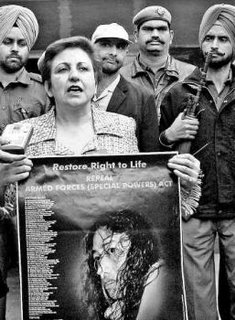
Curiously, it took Iranian Nobel Peace prize winner Shirin Ebadi to raise proportionate heat on Irom Sharmila in a recent trip. “If Sharmila dies, Parliament is directly responsible,” she thundered at a gathering of journalists. “If she dies, courts and judiciary are responsible, military is responsible… If she dies, the executive, the PM and President are responsible for doing nothing… If she dies, each one of you journalists is responsible because you did not do your duty…”

Our Gandhigiri conscience

Yet we who have discussed Lage Raho Munnabhai and the great advent of Gandhigiri in India 2006 across channels and papers, have remained steadfastly oblivious to Irom.

It is a parable for our times.

If the story of Irom Sharmila does not make us pause, nothing will.

It is a story of extraordinariness.

Extraordinary will.

Extraordinary simplicity.

Extraordinary hope.

It is impossible to get yourself heard in our busy age of information overload. But if the story of Irom Sharmila will not make us pause, nothing will!!


Credits: Tehelka.com for the original story, abridged here.

Tuesday, October 03, 2006

Bande mein tha dum - Remembering Gandhi...

Yesterday was Gandhi Jayanti, the birth anniversary of Mahatma Gandhi, one of the greatest leades of the last century. I received 7 sms conveying best wishes for the day. This is roughly 7 more than what I received last year. Is there a resurgence of Gandhi 58 years after he was silenced by 3 bullets? Or is this short lived euphoria over the success of a comic film? Whatever it is... lage raho!!

According to historian Michael H Hart, there are three ways to judge the success of a person:

(i) The smallness of means;
(ii) The greatness of purpose; and
(iii) The results achieved.

MEANS...

If we look at Gandhi through these lenses we find that he was a frail short man (5 ft 3") with no political godfather, no family business to fall back on, no support.. infact nothing as apparent means. What he did have was greatness of purpose and his tools of Ahimsa (non-violence), Satya (Truth) and Simplicity.

PURPOSE...

His purpose was great - to take on the entire British empire - perhaps more daring than someone taking on the USA today for seeking freedom for a fifth of the world's population and ... that's the catch... WITHOUT ANY VIOLENCE. These surely make the plan great... I mean greatly difficult to achieve. I daresay none of us would even have the courage to take up such a task!

But Ah! ... he had COURAGE, in capital bold letters, font 220 ... and that arose because of his clear conscience and adherence to Truth and non-violence. How many of us would have the courage when we are to meet the King of the British Empire (as Gandhi was invited to in 1913), to go there in our dhoti and shawl and on being asked if we weren't under-dressed for the occasion, coolly reply, "His Highness was wearing enough for both of us!"

True... one man with courage makes a majority!!

RESULTS...

And the results - they speak for themselves - freedom achieved without violence, an exemplary ascetic life, the respect of seniors and the love of children, a storehouse of writings (atleast 50,000 pages, as published by the Government of India) and the spiritual father to non-violence adherents such as Martin Luther King, Nelson Mandela, Dalai Lama and Aung San Suu Kyi among others.

SO...

Einstein said of Mahatma Gandhi (and no, he had never met him, only corresponded with him) - "Generations to come will scarce believe that such a one as this ever in flesh and blood walked the earth"

We, as heirs of the Gandhi legacy, have a right, nay a duty, to create India's identity with Gandhi's ideals - showing to the world that we deserve and respect Gandhi's heritage, of providing alternate solutions to the conflict and problems in the world today. As Gandhi said, "What difference does it make to the dead, the orphans, and the homeless, whether the mad destruction is wrought under the name of totalitarianism or the holy name of liberty and democracy?"

Let our remembrance not be short-lived. Let us adopt his ideals in our life..

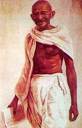
Let us remember this picture in all that we do from now on:


In all our actions, in all our speech, in all our thoughts, let us think WWGD - 'What Would Gandhi Do In This Situation'.. and then act accordingly.

Saturday, July 01, 2006

Amrapali’s Encounter with The Handsome Renunciate

From a post by P VENKATESH on the Speaking Tree (Times of India)

An interesting story on happiness and true pleasure...

The most attractive thing in Vaishali, the capital city of Lichhavis, was the beautiful dancer Amrapali. She was named after the mango grove she was first found in. Everybody was eager to win her love. She chose to be the Nagar-vadhu, wife to the whole city.

One day, Amrapali saw a young monk. Mesmerised by his calm and attractive pre-sence, she followed him. The sanyasi settled down beneath a mango tree, unmindful of her presence. Unable to attract his attention, she spoke: “Sir, please introduce yourself. Why do you lead an ascetic life in your youth?” “In search of Truth”, replied the monk. Amrapali was first taken aback. She then teased him: “Of what use is the Truth that wastes your youth?” The monk smiled: “Lady, Absolute Happiness can only be attained thus for the happiness you seek is transitory pleasure”.

Amrapali persisted. “Dear, leave this delusion and enjoy my hospitality which even royalty desires to experience”, offered Amrapali. The monk thought for a moment and said, “I will ask my master. If he allows me, I will come”. Then he took out a ripe Amra Phal (mango) from his bag and gave it to her with the instruction that the fruit be preserved without decay till his return.

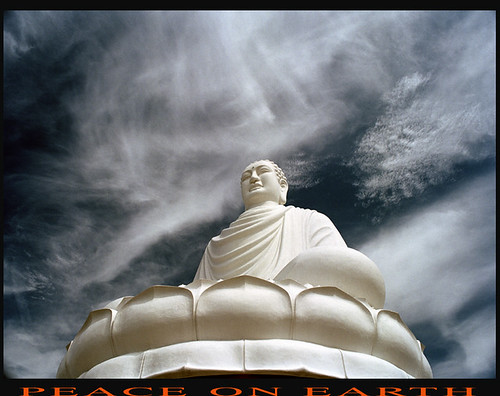
The monk returned to Buddha’s shelter and narrated the incident. Buddha gave him permission to stay with Amrapali, much to the puzzlement of other disciples. Buddha calmly said, “I have looked into his eyes — there was no desire. If I had said ‘no’, even then he would have obliged. I trust his meditation”.

In the meantime, Amrapali tried all methods to keep the mango fresh, but failed. After one month, the young monk returned. Passionately infatuated, she approached him. The monk ordered, “Lady! Bring me the Amra Phal”. She did so; but the mango had decayed, emitting foul odour and was full of worms. She asked, “Dear, of what use is this rotten fruit to you?” The monk slowly removed the mango-stone from the fruit. Showing her the rotten skin, he spoke, “Where has the beauty, aroma and taste of the fruit gone? Whereas, the mango-stone is intact and free of decay”. “Of what use is this mangostone”, argued the courtesan.

The monk smilingly explained, “The mango-stone is the most useful. As a seed, it has the potential to regenerate a new body. Likewise, a human being’s meditation is never wasted. This mangostone signifies the eternal Soul. The protection of the Soul is the real shield; that is the absolute Happiness. Recognise this Truth, Amrapali. You, who could not save the decay of this Amra Phal, how long can you protect your own body from disintegration?”

The Nagarvadhu was speechless; it was as if she had been awakened from a deep sleep. Moved, she asked forgiveness of the young monk. She felt cleansed and expressed her desire to see the monk’s master. Later, Buddha visited Vaishali and stayed at Amrapali’s abode. She touched Buddha’s feet and said, “I tried my best to attract your monk, but he convinced me by his awareness that real life is in your shelter”. She renunciated the life of a courtesan and donated her belongings to the Buddhist Sangha.

Tuesday, June 27, 2006

On human happiness...


"Now and then it's good to pause in our pursuit of happiness and just be happy", so said Guillaume Apollinaire, the foremost French poet of the early 20th century. The quest for happiness has been the single purpose of human existence. And often in vain.

In a world of strife, we have ensured that happiness is a distant dream for many; and survival more important than happiness.

When does a human being achieve happiness and how can it be measured? Is 'fun' as perceived today a quick pill for happiness? Or do we program ourselves to remain unhappy?

The Master claimed that a major reason for unhappiness in the world is the secret pleasure people take in being miserable.
He told of a friend who said to his wife, "Why don't you get away and have a good time, darling?"
"Now, dear, you know perfectly well that I never enjoy a good time!"
(Anthony de Mello, S.J.)

Saturday, January 01, 2005

Hi.. Welcome to my world

Hi,

I am a fellow human being... call me Abrahim for convenience....

Welcome!!